Prison Retaliation: How Staff Silence Whistleblowers and Inmates


Prison retaliation is one of the most serious problems inside the American correctional system — and one of the hardest to see from the outside.
In my years following prison retaliation cases, I have learned to pay close attention to what happens after somebody speaks up. The original complaint may involve excessive force, sexual abuse, unsafe conditions, falsified records, medical neglect, or staff misconduct. But the next few days or weeks can tell you just as much about the institution as the complaint itself.
A grievance gets filed.
Then a disciplinary report appears.
A staff member contacts an outside investigator.
Then their work record suddenly becomes a problem.
An incarcerated person reports abuse.
Then they are transferred, placed in isolation, searched repeatedly, stripped of privileges, or told they violated a rule that had never caused trouble before.
None of those administrative actions automatically proves retaliation. Prisons have legitimate reasons to transfer people, impose discipline, conduct searches, change housing assignments, and restrict privileges. I have never believed every unpleasant decision after a complaint is retaliatory.
But timing matters. Patterns matter. Documentation matters.
And documented cases show that retaliation in prisons can happen precisely because the ordinary machinery of a correctional institution gives staff so much control over the person who complained.
That is the part outsiders often miss.
If I complain about misconduct in an ordinary workplace, I can leave the building at the end of the day. An incarcerated person cannot. They still depend on the institution for food, housing, medication, phone access, movement, mail, recreation, medical care, and physical safety. A correctional employee who reports colleagues may still have to work beside those same people on a dangerous unit the next morning.
Prison retaliation works because the threat does not have to be dramatic.
Sometimes the message is delivered through paperwork.
Sometimes through a housing assignment.
Sometimes through silence.
And sometimes the person who speaks up watches what happened to somebody before them and decides never to file the complaint at all.
Before I get into the cases, I want to mention a book that changed the way I think about institutional silence inside corrections. Corrections Corrupt: A True Corrections Officer Story comes from someone who spent nearly two decades working inside an adult male correctional institution, and that firsthand view helps explain why fear, loyalty, and informal staff culture can carry as much weight as written policy.
A firsthand account from nearly 20 years inside corrections — told without filter.
Quick Answer: What Is Prison Retaliation?
Prison retaliation happens when an inmate, staff member, or whistleblower is punished, threatened, targeted, transferred, written up, isolated, or pressured after reporting misconduct, unsafe prison conditions, abuse, prison corruption, or policy violations.
The important word there is after.
Retaliation is usually about cause and motive. A disciplinary action may be valid on its face. A transfer may be permitted under prison policy. A cell search may be routine.
The question is whether that action happened because the person exercised a protected right, reported wrongdoing, cooperated with investigators, or used the inmate grievance process.
That is why prison retaliation cases can be so difficult to prove.
The institution may control the records that establish timing. Staff members write disciplinary reports. Administrators approve housing moves. Internal investigators interview witnesses. The facility keeps video footage. The prison decides whether a grievance was filed correctly and whether it will proceed.
The person alleging retaliation often starts with nothing more than the sequence of events and their own account.
That imbalance gives prison staff retaliation enormous power when oversight is weak.
What Prison Retaliation Looks Like
False disciplinary reports
One of the patterns I watch most closely in prison retaliation cases is the sudden appearance of disciplinary charges after someone complains.
Before the complaint, the person may have a relatively ordinary disciplinary history.
Afterward, everything changes.
Insolence.
Disrespect.
Failure to obey.
Disruptive behavior.
Interference with institutional operations.
Any of those can represent real misconduct. Prisons need enforceable rules. But a disciplinary report also has enormous consequences inside a correctional facility. It can affect privileges, housing, program access, release opportunities, classification, and credibility during a later investigation.
That makes a false disciplinary report a powerful retaliatory tool.
A documented case involving an incarcerated man identified in court records as J.M. shows why I take the pattern seriously. In November 2023 at U.S. Penitentiary Atwater in California, correctional officer Sandra Munagay punched J.M. during an encounter later captured on surveillance video. Munagay subsequently admitted the punch and, in February 2026, pleaded guilty to falsifying her report about the incident in an attempt to obstruct the investigation.
What happened afterward is central to the retaliation issue. J.M. was transferred that night to another federal facility and later placed in solitary confinement on disciplinary accusations including threats, insolence, and refusing orders. His attorneys have described the treatment that followed his complaint as retaliation; those retaliation allegations remain claims rather than criminal findings against the other staff involved.
That distinction matters.
I do not need to assume every allegation is true to see why the case matters. The officer’s admitted false report shows how quickly an official record can become unreliable when the person writing it is also involved in the underlying incident.
Housing changes and transfers
A transfer looks administrative.
Inside prison, it can change almost everything.
A person can be moved hundreds of miles from family. Their legal materials can be delayed. A job or educational program can disappear. Medical treatment can be interrupted. A relatively open facility can be replaced by a much more restrictive one.
That is why I never dismiss a transfer as meaningless when it immediately follows a complaint.
At Federal Prison Camp Bryan in Texas, reporting by The Marshall Project and NBC News documented the experience of a woman identified as R. who reported sexual encounters with prison employees. Bureau records said she was transferred because of alleged involvement with contraband vapes, which she denied. R. later wrote in a grievance that the move to a harsher detention facility felt like punishment and that, had she known what would happen, she would not have come forward.
That sentence captures the purpose retaliation can serve even when motive remains disputed.
The punishment does not only affect the person being moved.
Everyone watching learns from it.
Loss of privileges
Phone calls.
Visits.
Recreation.
Commissary.
Work assignments.
Educational programs.
Movement.
These things may sound minor compared with physical abuse, but they are the structure of daily life inside a prison.
An officer does not need to threaten someone openly if the message can be sent by repeatedly interfering with the few things that make incarceration bearable.
That is why inmate retaliation can be so difficult to document. A missed recreation period may mean nothing. A delayed phone call may be ordinary. A program reassignment may be legitimate.
But when those changes begin immediately after an inmate grievance, especially alongside write-ups, searches, or verbal hostility, investigators should examine the pattern rather than treating every incident in isolation.
Threats and intimidation
Some retaliation is much less subtle.
Investigative reporting on the federal prison grievance system has documented incarcerated people describing officers threatening them for filing complaints and refusing to provide grievance forms.
That kind of threat strikes directly at the prison complaint process.
If the same employee accused of misconduct can decide whether you receive the form needed to report that misconduct, the process is already compromised.
I have reviewed enough grievance disputes to know that the first barrier to accountability is sometimes not losing the case.
It is getting the complaint filed at all.
Being labeled a snitch
Few words carry more danger inside a correctional institution than “snitch.”
For incarcerated people, that label can affect physical safety. Other prisoners may see cooperation with staff or investigators as betrayal.
For officers, the dynamic is different but the social pressure can be just as real.
A correctional employee who reports a coworker may be viewed as somebody who cannot be trusted. In a job where employees depend on each other during fights, medical emergencies, disturbances, and unpredictable confrontations, that label carries weight far beyond workplace gossip.
Prison whistleblower retaliation does not always require an official disciplinary action.
Isolation from coworkers can do the job.
So can a supervisor who suddenly stops supporting the employee.
So can the quiet understanding that everybody knows who talked.
Real Prison Retaliation Cases and Common Patterns
Retaliation after filing grievances
The grievance system is supposed to give incarcerated people a formal way to report abuse, unsafe conditions, and correctional officer misconduct.
The problem is that the process often requires the person complaining about staff to begin that complaint inside the same institution.
A 2026 investigation by The Marshall Project and NPR analyzed nearly one million federal grievance cases dating back to 2000. It found that fewer than 2 percent of federal prison grievances decided in 2023 were granted. Large numbers were rejected for procedural problems or administratively closed before reaching the substance of the complaint.
Those figures alone do not prove retaliation.
What troubles me more is the structure around them.
People in federal custody generally must exhaust the prison’s administrative remedy process before pursuing many claims in federal court. That means access to the grievance system can determine access to a courtroom.
If staff block forms, lose paperwork, threaten complainants, or create disciplinary consequences for people who persist, prison complaint retaliation can become a barrier to outside accountability.
That is why the grievance process is not simply paperwork.
It can be the gateway to legal rights.
Retaliation after reporting staff misconduct
Inmate grievance retaliation becomes especially dangerous when the complaint involves the same officers who control a person’s daily life.
I keep coming back to FCI Dublin in California because the facility became a national example of what happens when sexual abuse allegations, retaliation fears, and weak institutional accountability collide.
Aron Laureano, who spent two years at Dublin, later described being punished after attempting to complain about abuse. According to a federal lawsuit and her account reported by The Marshall Project and NPR, staff placed her in solitary confinement, restricted visits and phone calls, and confiscated property after she reported misconduct. Laureano also said an officer came to her cell and referred to details from her written grievance in front of other incarcerated women.
That last detail stays with me.
A confidential complaint process becomes almost meaningless if the complainant immediately learns that the people inside the facility know exactly what she wrote.
FCI Dublin closed in 2024 after years of sexual-abuse scandals and criminal prosecutions of staff members. Court-supervised reforms later included specific protections against retaliation and review of potentially invalid disciplinary reports issued by Dublin staff.
Retaliation against staff who report abuse
Prison retaliation does not stop at the cell door.
Employees can become targets too.
Ashley Anderson had worked at Federal Prison Camp Bryan in Texas for years when, according to reporting by The Marshall Project and NBC News, she began raising concerns after an incarcerated woman told her about alleged sexual misconduct by staff.
Anderson said she first reported concerns inside the facility and later contacted federal oversight officials. During 2024 and 2025, she sent repeated memos up the Bureau of Prisons chain alleging that several employees had abused incarcerated women while remaining employed.
Anderson and another employee who reported misconduct were later fired. Bureau disciplinary allegations against them included workplace violations and, among the cited conduct, carrying out an “unauthorized investigation” by collecting information about staff wrongdoing. Anderson and her colleague have challenged their terminations, and the reporting describes their position that the firings were retaliation for exposing abuse.
The Oklahoma case involving psychologist Dr. Whitney Louis raises a similar concern.
Louis told prison investigators in July 2022 that administrators at the Dr. Eddie Warrior Correctional Center were not adequately following up on allegations of sexual abuse involving incarcerated women. The Oklahoma Department of Corrections fired her approximately six months later, in January 2023; Louis maintained that the termination was retaliation for her reporting. Two administrative law judges later ordered that she be reinstated, while the department disputed her allegations and continued challenging that outcome, and state lawmakers continued scrutinizing the case into 2024.
Another case I keep coming back to involves Ara Kimbrough at Bucks County Correctional Facility in Pennsylvania. Kimbrough, a longtime corrections employee and administrative lieutenant, alleged that in 2024 he spoke off duty with an attorney representing the estate of an inmate who had died from an overdose, telling the lawyer that chronic understaffing and the county’s failure to correct it had contributed to unsafe conditions. County officials investigated Kimbrough after learning about the conversation and fired him; in February 2025, a federal judge held that he had plausibly stated a First Amendment retaliation claim against individual officials and allowed that claim to proceed. To me, the case is a sharp reminder that prison whistleblower retaliation can reach employees who take institutional concerns outside the normal chain of command.
Retaliation disguised as routine discipline
The hardest retaliation to prove is the kind that looks perfectly ordinary on paper.
A write-up.
A search.
A transfer.
A schedule change.
A denied request.
A lost job assignment.
None of those actions is inherently improper.
That is exactly why they can work so effectively as retaliation.
When I examine prison retaliation cases, I look at sequence.
Was the person treated differently before the complaint?
How quickly did discipline follow?
Did supervisors know about the protected report?
Were the rules applied consistently to others?
Did the institution provide a documented security reason for the action?
Does video match the written explanation?
Is there a pattern of similar treatment toward other complainants?
Retaliation is often hidden in those details.
The institution may call the action routine.
The timeline may tell a different story.
How the Inmate Grievance Process Can Fail
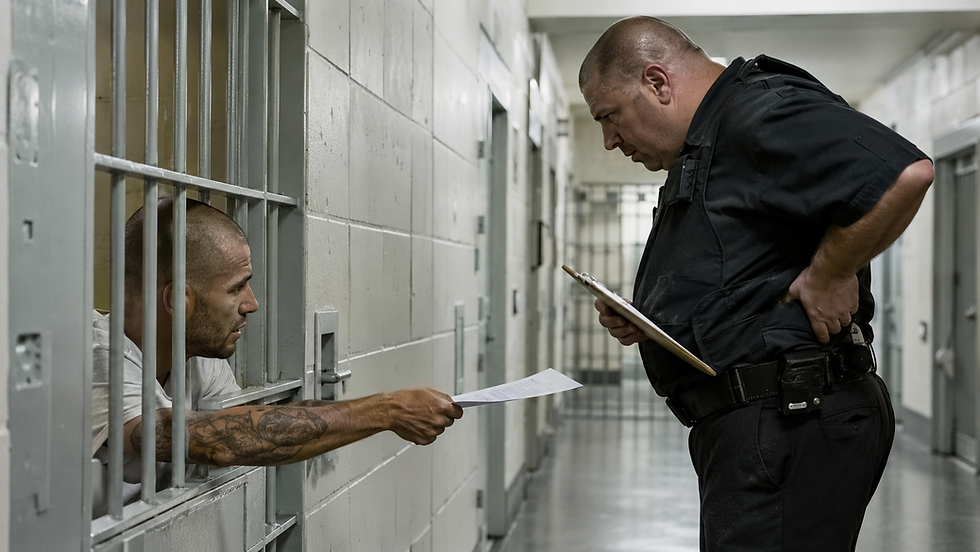
The inmate grievance process is supposed to provide an orderly way to report problems without resorting to confrontation, violence, or outside litigation.
That makes sense in theory.
In practice, the system can place enormous responsibility on the person with the least power.
An incarcerated person may have to obtain the correct form, meet strict deadlines, describe the issue in a limited space, submit it to prison staff, wait for an internal response, appeal through additional administrative stages, and preserve enough documentation to later prove exhaustion in court.
Miss one technical requirement and the complaint can fail before anyone decides whether the underlying abuse occurred.
A May 2026 Government Accountability Office report on sexual abuse in federal prisons found serious concerns about reporting and retaliation. Among the incarcerated people GAO interviewed at four federal facilities, 61 percent said someone reporting sexual assault by a BOP employee could face retaliation from employees. Examples described to investigators included retaliatory searches, disciplinary write-ups, humiliation, property disruption, and placement in the Special Housing Unit.
Those interviews were not statistically representative of every person in federal custody, and I would not present them that way.
But they show why trust matters.
A grievance system can be perfectly designed on paper and still fail if the people expected to use it believe using it will make them less safe.
The psychological effects of solitary confinement make that risk even harder to ignore. If an incarcerated person believes filing an abuse complaint could result in isolation — whether officially justified or retaliatory — the threat of the Special Housing Unit can silence a complaint before it is ever written.
A grievance process without credible protection against retaliation is not enough.
The system has to make reporting safer than silence.
Prison Whistleblower Retaliation Against Staff
Why staff may fear reporting misconduct
Correctional officers depend on coworkers differently than people in most jobs.
A colleague may be the person who responds when an argument suddenly becomes violent.
The officer on the next unit may be the backup during an assault.
Supervisors decide assignments, schedules, training opportunities, overtime, evaluations, and recommendations.
Those relationships create legitimate teamwork.
They can also create pressure.
If reporting a coworker means losing the trust of the group, an officer may calculate the consequences before saying anything.
That is why I do not treat prison staff silence as a simple question of courage.
Institutions have to create conditions in which honesty does not carry a professional penalty.
The code of silence
The code of silence does not need to be written down.
Everybody can understand it anyway.
Do not embarrass the unit.
Do not create problems for another officer.
Handle things internally.
Do not give outsiders information they can use against the institution.
Those expectations can grow in any closed organization, but prisons are particularly vulnerable because staff spend so much time working behind restricted walls with limited outside observation.
The code becomes dangerous when loyalty outranks accuracy.
If an officer watches another employee use excessive force and alters the report to protect them, that is not teamwork.
If staff know somebody is smuggling contraband and stay silent because reporting will create conflict, that silence creates risk for everybody.
If an employee witnesses retaliation and decides the safest option is to pretend it never happened, the institution’s formal record becomes less truthful.
That is how staff silence in prisons can protect misconduct without any supervisor openly ordering a prison cover-up.
How silence protects the institution
Institutions are judged by their records.
How many complaints were filed?
How many were substantiated?
How many officers were disciplined?
How many abuse allegations occurred?
How many grievances were resolved?
If people are afraid to report, those numbers can make a troubled facility look healthier than it really is.
That is one reason I distrust low complaint numbers when they appear without context.
Low complaints may mean a well-run prison.
They can also mean people have learned not to complain.
Internal investigations in prisons depend on witnesses coming forward, evidence being preserved, and reports being accurate. Remove any one of those elements and oversight weakens.
Remove all three and an institution can produce a clean paper record while serious misconduct remains hidden behind it.
How good officers are harmed
Prison staff retaliation hurts the officers who are trying to do the job correctly.
A professional officer wants clear rules.
They want coworkers who can be trusted.
They want supervisors who will back lawful decisions and challenge unlawful ones.
They want to know that if they report misconduct, the system will investigate the misconduct instead of investigating the person who spoke.
When those protections disappear, good officers face an ugly choice.
Speak and risk professional consequences.
Stay silent and work beside behavior they believe is wrong.
Neither option creates a safer prison.
That is why whistleblower protection is not anti-corrections.
It is part of professional corrections.
After years of reading investigations from outside the walls, I have come to value accounts that explain what that pressure feels like from inside. Corrections Corrupt: A True Corrections Officer Story gives readers that missing view — the daily culture, the relationships between staff, and the consequences that never fit neatly inside an investigative report.
Craig P. Wallin writes from nearly two decades of direct experience inside an adult male correctional institution.
Why Retaliation in Prisons Is Hard to Prove
The prison controls the records
Evidence matters.
The problem is that much of the evidence needed to prove prison retaliation is created and held by the institution itself.
Incident reports are written by staff.
Housing decisions appear in prison databases.
Disciplinary charges are processed internally.
Surveillance footage is stored by the facility.
Medical records require institutional access.
Movement logs, phone records, job assignments, visitation records, and grievance files all pass through the prison.
An inmate trying to prove retaliation may need those records to show that treatment changed immediately after a complaint.
A staff whistleblower may need emails, evaluations, scheduling records, or disciplinary history to show that their career changed after they reported misconduct.
If investigators cannot independently preserve and review those records, the person alleging retaliation enters the case at a major disadvantage.
Witnesses may be afraid
Prison witnesses do not testify from a neutral environment.
An incarcerated witness may continue living on the same unit.
A staff witness may still work beside the person being investigated.
That reality changes what people are willing to say.
I have read cases where investigators later discover that witnesses knew much more than they initially disclosed. That does not necessarily mean the witness wanted to protect abuse.
Fear can produce silence.
So can uncertainty.
So can the simple knowledge that an investigation will end while the witness still has to live or work inside the facility.
Strong prison accountability has to account for that risk.
Retaliation can look like routine discipline
This is the central problem.
Prisons must discipline people.
They must move people.
They must search cells.
They must change jobs.
They must separate individuals who pose safety threats.
Retaliation laws do not eliminate legitimate correctional authority.
The challenge is separating a valid security decision from punishment motivated by protected speech.
That is why timing and comparison matter so much.
If an inmate broke the same rule repeatedly before complaining and was never disciplined, then received maximum punishment immediately after filing a grievance, investigators should ask why.
If a highly rated employee reports abuse and suddenly receives a cascade of minor disciplinary charges, the history matters.
The action may still be legitimate.
But it deserves scrutiny.
Internal investigations may protect the institution
Internal investigations in prisons serve a necessary role.
Many investigators do serious work, and not every internal investigation is corrupt.
The structural problem remains: the institution is often investigating itself.
An investigator may report through the same administration facing criticism.
Witnesses may know one another.
Supervisors may have approved the action now under review.
The facility may face civil liability if retaliation is substantiated.
That creates incentives that independent oversight is designed to counter.
When the investigation treats the official explanation as presumptively correct, prison complaint retaliation becomes much harder to prove.
Without outside review, the institution’s finding may become the only record future investigators ever see.
How Prison Oversight Failures Allow Retaliation to Continue
Retaliation thrives in the space between policy and enforcement.
Most correctional agencies have rules prohibiting retaliation.
Most have grievance procedures.
Most have internal affairs investigators.
Many operate under the Prison Rape Elimination Act’s anti-retaliation requirements.
The real question is whether those protections work after somebody files the complaint.
The 2026 GAO review of federal prisons is useful here because it documented both policy and fear at the same time. BOP officials told investigators that people who report sexual abuse are monitored for signs of retaliation for at least 90 days. Yet incarcerated people interviewed by GAO still described fears that staff could retaliate through searches, write-ups, humiliation, property disruption, or special housing placement.
That gap is prison oversight in miniature.
The policy says retaliation is prohibited.
The person inside still believes retaliation can happen.
Both facts can exist at once.
That is where prison corruption and correctional officer misconduct intersect with retaliation.
Misconduct creates the complaint.
Retaliation discourages the complainant.
A weak investigation protects the retaliatory act.
Future witnesses learn from what happened.
Then the next incident becomes less likely to be reported.
That cycle will not break simply because a policy manual says it should.
The Damage Caused by Prison Retaliation
Harm to inmates
For incarcerated people, retaliation can alter the entire experience of confinement.
Placement in solitary confinement can strip away human contact.
A transfer can move a person far from family.
A disciplinary charge can affect programs, privileges, housing, and release opportunities.
Repeated searches and harassment can turn every interaction with staff into a source of anxiety.
But the deepest damage may be what happens to trust.
A person reports abuse because the institution tells them there is a process.
They use that process.
Their situation gets worse.
Then the institution asks why people do not report misconduct.
The answer is already there.
Harm to whistleblowers
Staff whistleblowers can lose more than a job assignment.
They can lose careers.
Professional relationships.
Income.
References.
Promotional opportunities.
A sense of physical security around coworkers.
Whitney Louis’s dispute with the Oklahoma Department of Corrections stretched far beyond the day she was fired.
Ashley Anderson’s concerns at FPC Bryan continued through repeated memos before her own employment ended.
Ara Kimbrough’s decision to speak to an attorney about conditions at Bucks County Correctional Facility led to an internal investigation, termination, and federal litigation over whether his firing violated the First Amendment.
Whether each claim ultimately succeeds through every stage of litigation is a legal question.
The broader institutional lesson is already visible.
If employees believe reporting serious problems can end their careers, some will stay silent.
Harm to honest officers
Good correctional officers do not benefit from retaliation.
They inherit the consequences.
They work in units where inmates distrust staff.
They depend on coworkers whose reports may not be reliable.
They enter tense situations made worse by earlier abuse.
They carry the public reputation created by officers who misuse authority.
And when they witness wrongdoing, they may have to choose between the professional standard written in policy and the informal expectation enforced by the workplace.
That is an unfair position to put them in.
A healthy correctional system should make honesty the safer choice.
Harm to public trust
Prisons operate largely outside public view.
That makes trust essential.
The public cannot personally verify what happens inside every housing unit.
Families cannot stand beside their loved ones during staff encounters.
Journalists cannot observe most disciplinary decisions.
Courts rely heavily on records created after the event.
When the public learns that complaints may trigger retaliation, every official record becomes harder to trust.
Was the discipline legitimate?
Was the transfer necessary?
Was the grievance really unsupported?
Did the witness change their story voluntarily?
Was the internal investigation complete?
Once an institution develops a reputation for punishing people who speak, those questions follow every future case.
A Corrections Officer's Perspective on Retaliation and Silence
The longer I study prison retaliation, the less I see silence as a simple moral choice.
People respond to incentives.
They watch what happens to others.
An incarcerated person sees someone file a grievance and end up in segregation.
A young officer watches an experienced coworker report misconduct and become isolated from the team.
A medical employee raises concerns and suddenly faces scrutiny of their own work.
Those examples teach people what the real rules are.
Not the policy manual.
The rules enforced by consequences.
That is what makes correctional culture so powerful.
A facility can post signs encouraging people to report abuse. It can hold annual training. It can create anonymous hotlines.
But if everyone knows that the last person who reported misconduct paid a price, the poster on the wall does not matter much.
That is why firsthand accounts matter so much to me when I write about correctional systems.
Investigative reports tell us what was documented.
Court records tell us what could be alleged, admitted, disputed, or proved.
Someone who worked inside a prison can explain how the pressure feels before anyone writes a report.
That is one reason I recommend Corrections Corrupt: A True Corrections Officer Story It gives readers access to the institutional culture that sits behind so many of these cases — the pressure, the loyalty, the compromises, and the silence that outsiders rarely see.
Why Accountability Matters
Accountability changes the calculation.
If an inmate knows an outside investigator will review retaliation claims, reporting becomes safer.
If an officer knows whistleblower protections will actually be enforced, honesty becomes less professionally dangerous.
If supervisors know video, disciplinary history, grievance timelines, and housing decisions will be independently reviewed, routine administrative authority becomes harder to misuse.
That is what accountability is supposed to do.
It does not require assuming every complaint is true.
Some allegations will be unsupported.
Some disciplinary decisions will turn out to be legitimate.
Some transfers will have real security reasons.
A credible accountability system should be able to say that too.
But the process has to investigate the facts rather than protect a preferred outcome.
Retaliation complaints should trigger review of timing.
Evidence should be preserved immediately.
Witnesses should be interviewed privately.
Disciplinary records before and after the complaint should be compared.
Housing and program changes should be examined.
Whistleblowers should be monitored for professional retaliation.
Inmates should have complaint channels that do not depend entirely on the staff members they may be accusing.
That is not anti-officer.
It is anti-retaliation.
And in my experience covering correctional accountability, good officers have just as much reason to want that system as incarcerated people do.
Read a Firsthand Corrections Officer Story
I have read enough court opinions, inspector general reports, federal audits, and investigative files to know that official documents only take you so far.
They can tell you what happened on a particular date.
They can identify which rule was violated.
They can show when a grievance was filed or when a disciplinary report appeared.
What they cannot fully capture is the atmosphere.
The pressure between coworkers.
The calculation that happens before somebody reports misconduct.
The way institutional loyalty develops.
The difference between the official rule and the rule everybody on the floor knows will actually be enforced.
That is why I think Corrections Corrupt matters.
Craig P. Wallin spent nearly 20 years inside an adult male correctional institution. He did not study correctional culture from a conference room. He worked inside it.
If you are reading about prison retaliation because you genuinely want to understand why whistleblowers stay silent, why inmates fear grievance systems, and why misconduct can survive inside institutions that already have rules against it, I would read this account now — while those questions are still fresh in your mind.
Not because one memoir explains every prison in America.
It does not.
Read it because firsthand experience fills a gap that audits and court records cannot.
Experience nearly 20 years of corrections work — told honestly, without filter.
Frequently Asked Questions
What is prison retaliation?
Prison retaliation occurs when an inmate, staff member, or whistleblower is punished, threatened, transferred, isolated, disciplined, or pressured after reporting abuse, unsafe conditions, misconduct, corruption, or policy violations inside a correctional facility.
What are prison retaliation cases?
Prison retaliation cases involve claims that inmates, staff, or whistleblowers were punished or targeted after reporting abuse, unsafe conditions, corruption, or misconduct. These cases can be difficult to prove because the institution often controls the records, witnesses, investigation process, and grievance system.
Can inmates face retaliation for filing grievances?
Yes. Retaliation can happen when inmates file grievances, report abuse, or complain about unsafe conditions — especially when oversight is weak, grievance forms must be submitted through staff, and no independent review exists to monitor what happens to the person after they file.
What does prison staff retaliation look like?
Prison staff retaliation can include undesirable shift assignments, professional isolation, hostile working conditions, false disciplinary charges, removal from programs, denial of promotional opportunities, and pressure from supervisors or colleagues not to cooperate with investigations.
Why is prison retaliation hard to prove?
Prison retaliation is hard to prove because the institution controls the records, witnesses may fear their own consequences for cooperating, retaliatory actions can be presented as routine prison administration, and internal investigations may protect the institution rather than pursue the facts.
How does retaliation connect to prison corruption?
Retaliation protects corruption by discouraging people from reporting misconduct or abuse. When inmates and staff learn that speaking up leads to punishment, the misconduct continues unreported. That silence allows corruption, false reporting, excessive force, and abuse to persist behind the institutional record.
About The Author

Craig P. Wallin is a former corrections officer with nearly two decades of experience inside an adult male correctional institution. His memoir, Corrections Corrupt: A True Corrections Officer Story, gives readers a firsthand look at prison life, institutional pressure, misconduct, and the realities that often stay hidden behind the walls.

Comments